

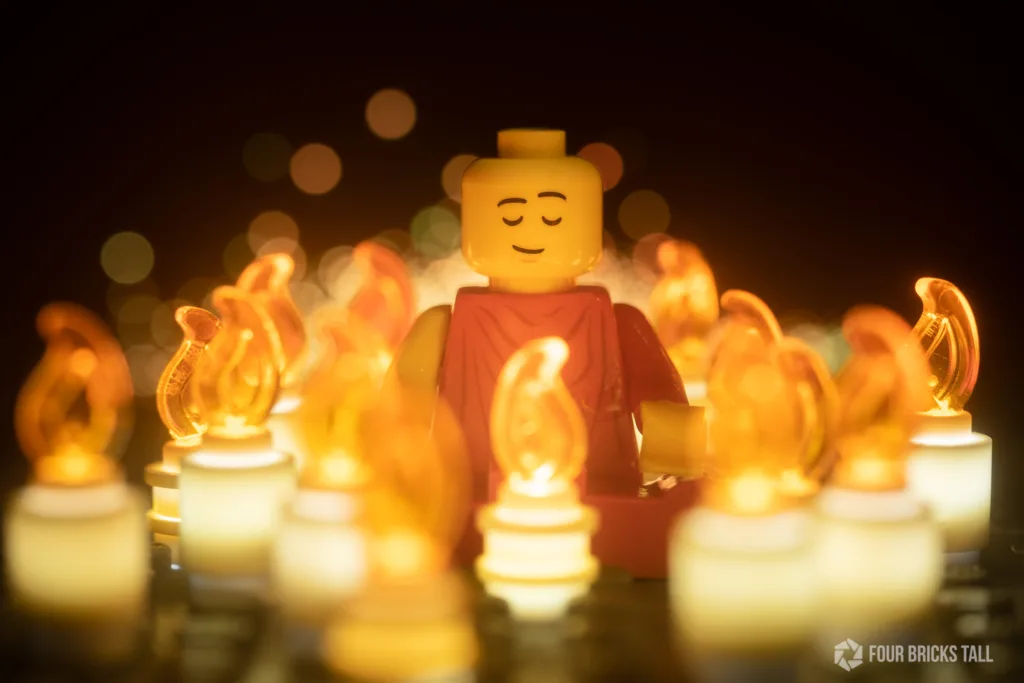
Most toy photographers light their scenes with whatever light is in the scene: a candle, a lantern, or a glowing crystal. If it’s a candle scene, the candles do the lighting. It makes sense, but it’s rarely enough.
Lights that appear in the frame are called practical lights, or practicals. They’re great for telling the viewer where the light is coming from. They’re usually terrible at actually lighting the subject. A tiny LED candle can’t light a minifigure’s face, let alone separate it from the background or show off the room it’s standing in.
The fix is to add light from outside the frame that looks like it’s coming from the practical. In cinema, this is called motivated lighting: using off-camera lights to enhance or imitate a source that exists within the scene. The practical motivates the light. The hidden lights do the work.
Nothing is real in toy photography
A lot of people resist motivated lighting because it feels like cheating. If the scene is lit by a single candle, shouldn’t the light look like it comes from a single candle?
No. You’re photographing plastic figures you posed, on a set you built, against a backdrop you chose, at a scale our eyes rarely see. Everything about the image is contrived. Holding the lighting to a standard of realism that nothing else in the frame meets doesn’t make the photo better. It makes it dimmer.
Realistic lighting also won’t get you the result you want. Real candlelight is dim, uneven, and doesn’t care about your story. You’re not documenting a room. You’re trying to make someone feel something, and light is one of the best tools you have for it.
That means the question isn’t “could this light physically exist?” Put a rim light on a monk where no light source should be and, if you ask a viewer, they might admit the scene looks lit. But they won’t be asking while they’re looking at the photo. If the light serves the story, they’re too busy feeling the scene to notice how it was made.
That’s the test. Not “is this realistic?” but “does this feel right, and does it stay out of the way?”
What this looks like in the movies
Here are behind-the-scenes images from the movies Spectre and Se7en, showing how lights placed outside the frame are really doing the job of those inside of it:
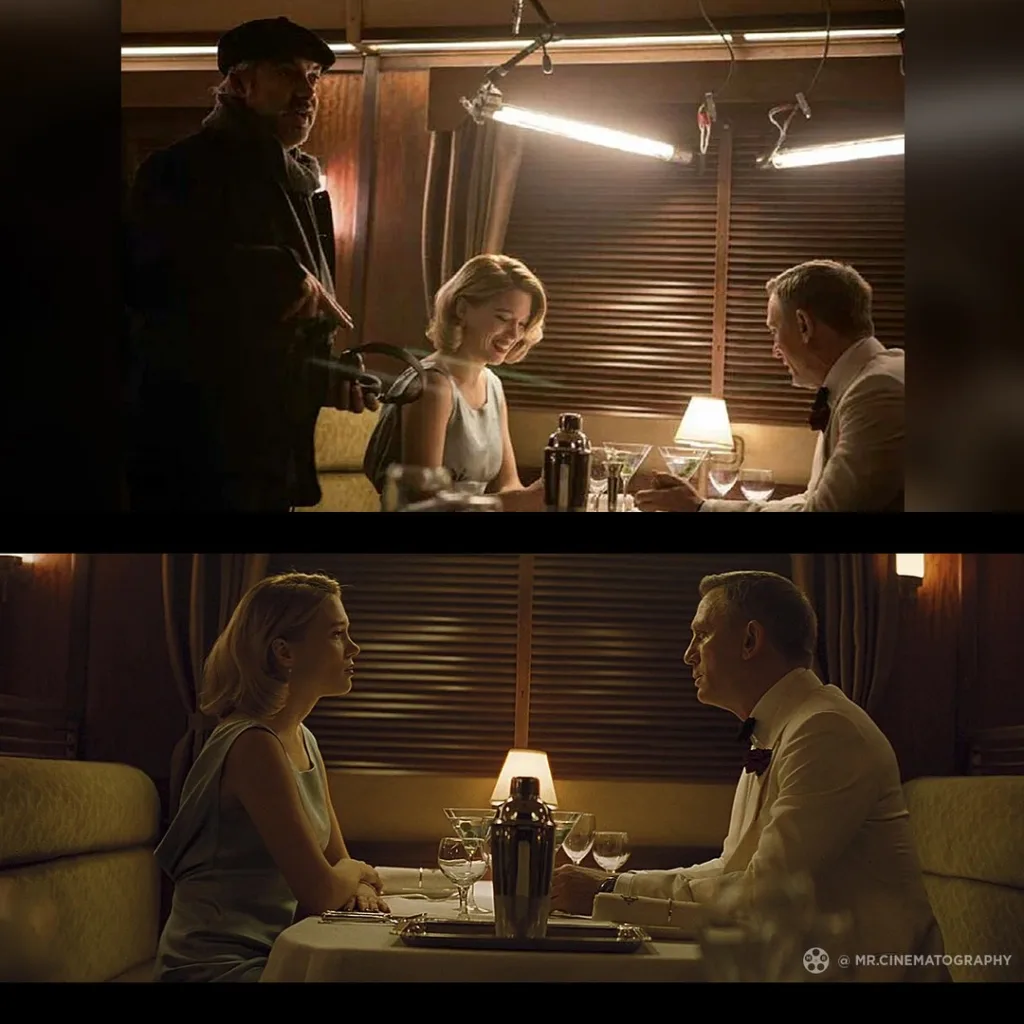
The lights placed over the actors in the Spectre BTS make it look like the light is coming from the wall sconces.
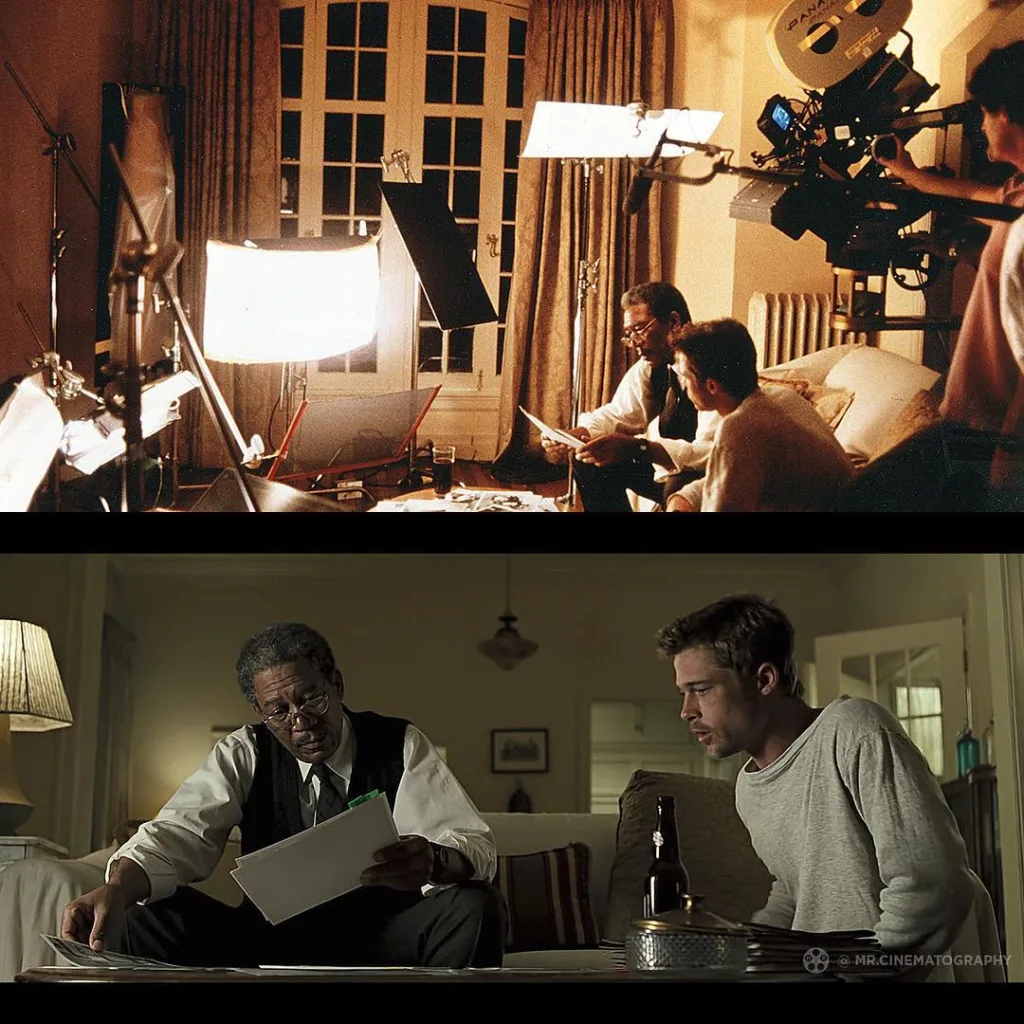
The large softboxes in the Se7en scene make it look like that lamp is illuminating the actors.
All those hidden lights out of frame motivate the various lamps inside the scene. The lamps in these frames tell you where the light comes from. The hidden lights are why you can see anything, and why it feels the way it does.
Motivating light in LEGO scenes
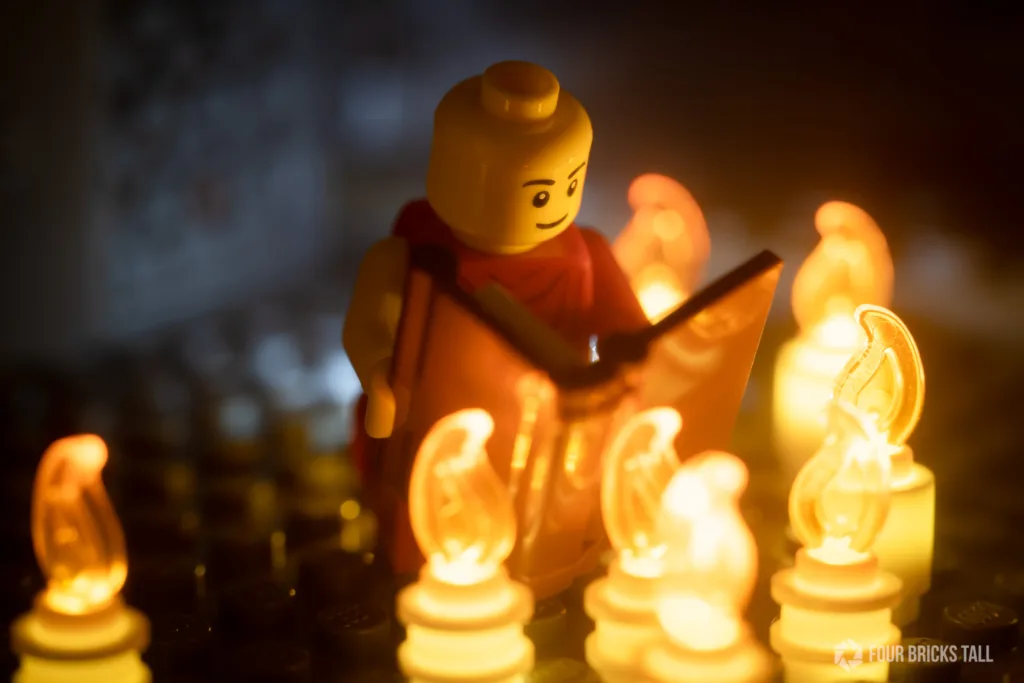
Here’s how that plays out in a LEGO scene. The scene is of a monk reading by candlelight. Here’s the finished photo:
And here’s the overhead BTS:
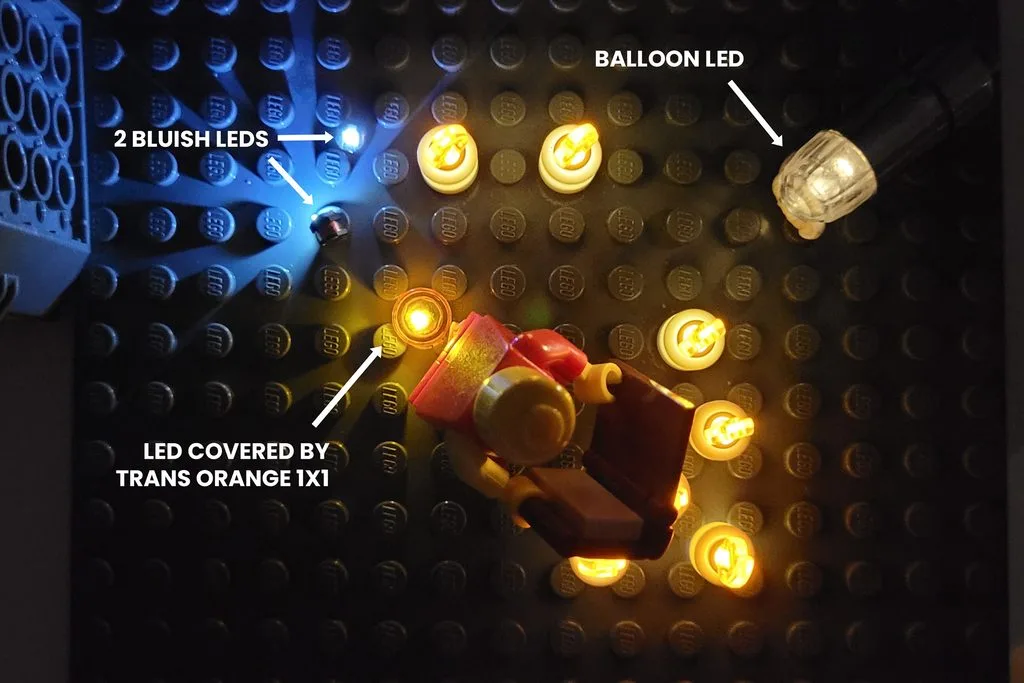
In the final photo, the viewer sees several candles illuminating the monk. What’s actually lighting the scene are the candles, plus four I added:
- Two white LEDs hidden behind the monk, pointed at the background. The cool white-bluish light contrasts against the yellow and red monk, and carves his shape from the background. It also lifts texture out of the shadows. Without it, everything behind him would go black, and the scene would look flat.
- One LED with a transparent orange LEGO tile (a “gel”) directly behind the monk, pointing up. This creates that orange glow on the ground, suggesting more candlelight reached that area than the candles really could.
- One balloon LED, out of frame, camera right, pointed at the monk’s face. These are low-powered LEDs designed to go inside party balloons. Just one lights the monk’s face, which would have been underexposed if it were lit by candles alone.
Now you know the setup; here’s the final shot again with notes on the effects of those additional lights:
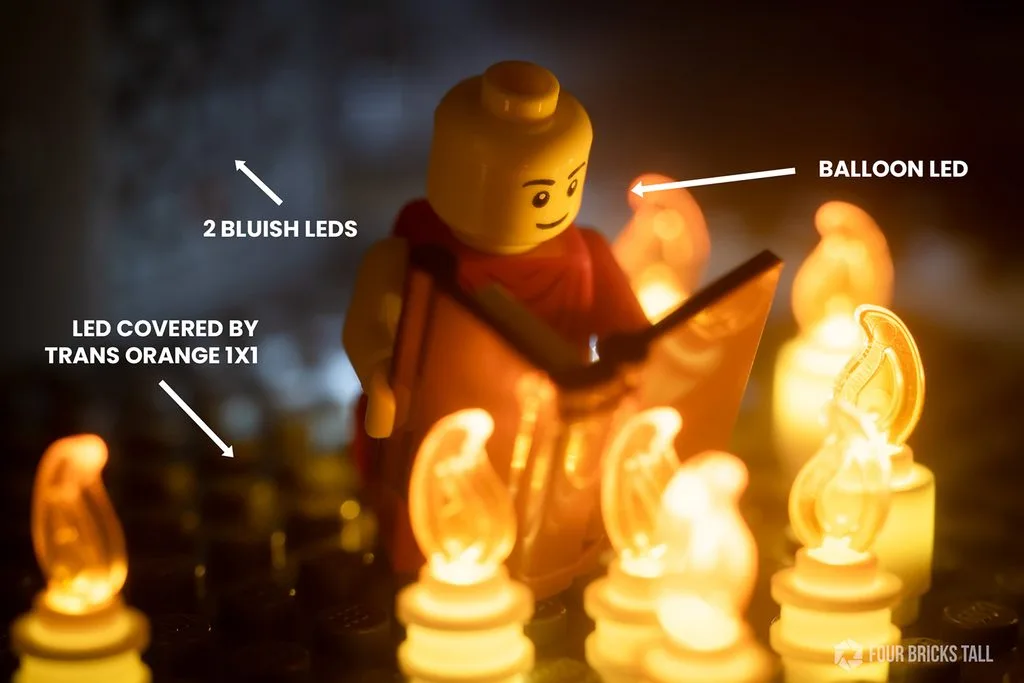
The balloon LED motivated the candles on the left of the minifig. Those candles weren’t blocked by the book he was holding, so it made sense that those illuminated the monk’s face.
More examples of motivating a light
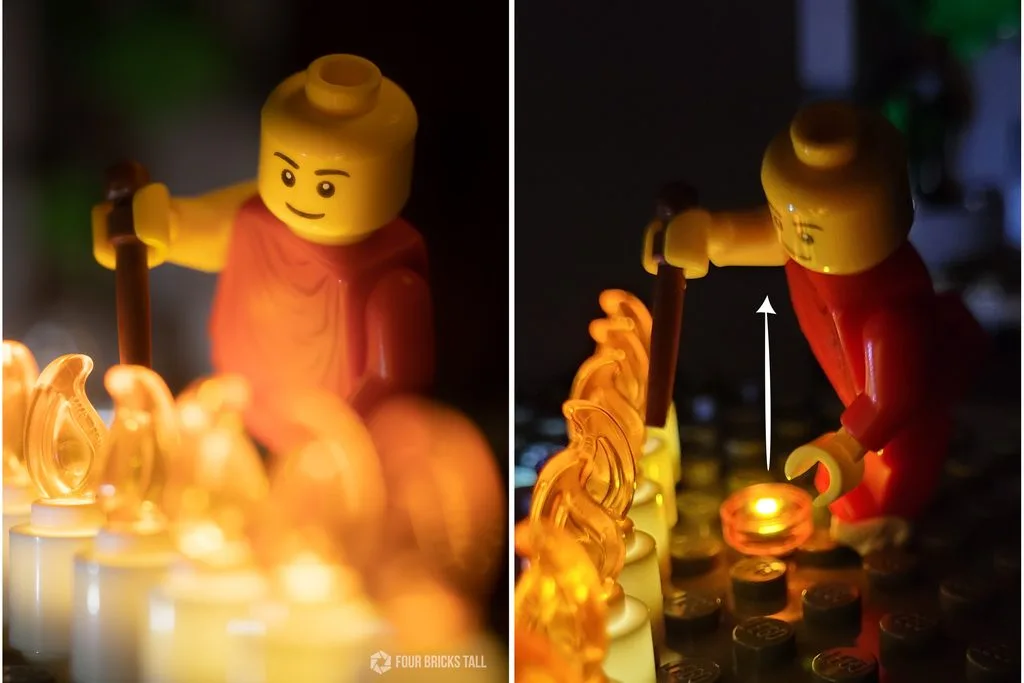
The same approach, different scenes. Here I lit the background just a little so some texture registers and added an LED at the feet to motivate the candles. Off camera, a balloon LED lit the monk’s head from behind to carve out his shape:
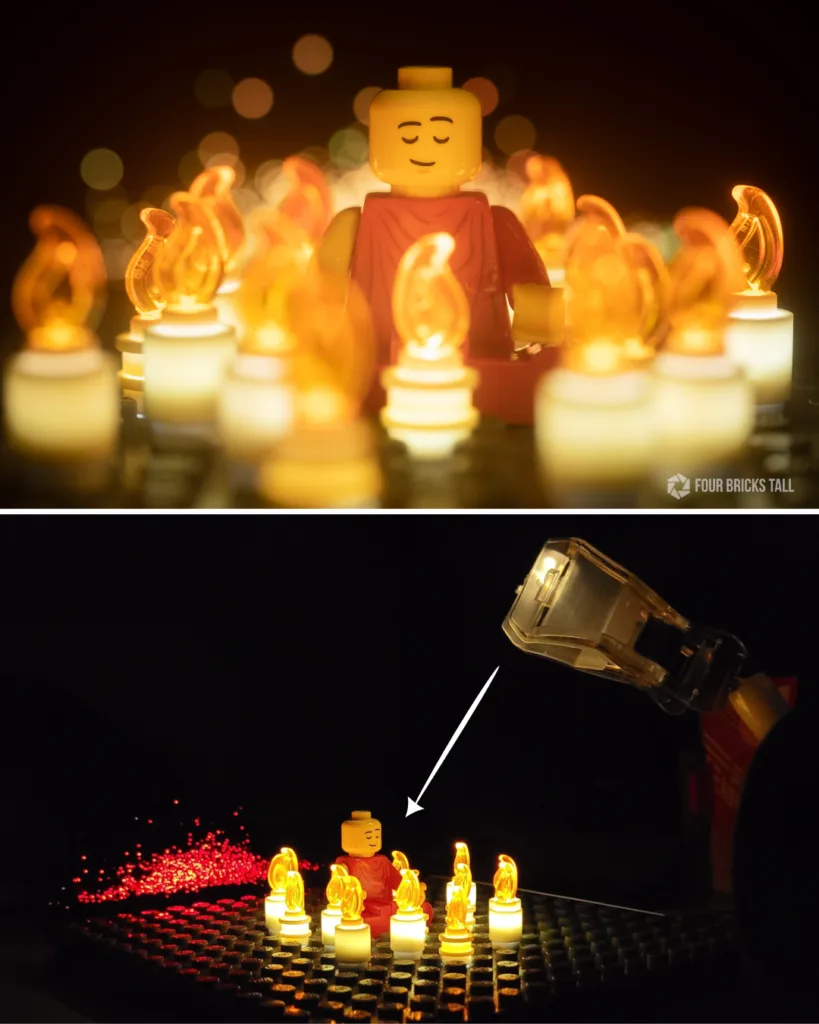
And here, I put fiber optic lights in the background and placed the balloon LED in a document clamp so I could easily point it downward at the monk’s torso:
How I light for feeling
- Start with the practical. Decide what the light source in the scene is. It gives the viewer a reason to accept everything else.
- Match the color of the practical. Candles are warm, so use warm color temperature light or gels from the hidden sources.
- Light where the eye should go. Face first. Then separation from the background. Then detail in the shadows. If you only have one hidden light, put it on the face.
- Start with believable placement, then break it on purpose. Put your first hidden light where the practical would plausibly cast it. Once that works, move lights wherever the story needs them: behind the subject, on the background, from below. The viewer won’t check your math.
- Don’t call attention to it. Keep the practical the star: hidden lights support it and never outshine it. If your hidden light is brighter than the candle, the viewer stops buying the candle. And if someone’s first thought is “that’s lit,” it’s too much. The goal is to light without looking lit.
Light creatively, not realistically
Lighting has a technical side, but like everything else in photography, it has an artistic side. If you’re telling a story, how real the light is matters far less than how it feels. Artistic choices don’t have to make perfect sense.
Try it on your next shot. Set up your scene with only the practical light and take a photo. Then add one off-camera light, placed near the practical and pointed at your subject’s face, and take another. Compare them. Which one makes you feel something? Which one would make a stranger stop scrolling?
Then move that light somewhere it has no business being and take a third.